Things to Do
Dalyan Rock Tombs (King's Tombs): History & Best Viewpoints
 DalyanEditorUpdated
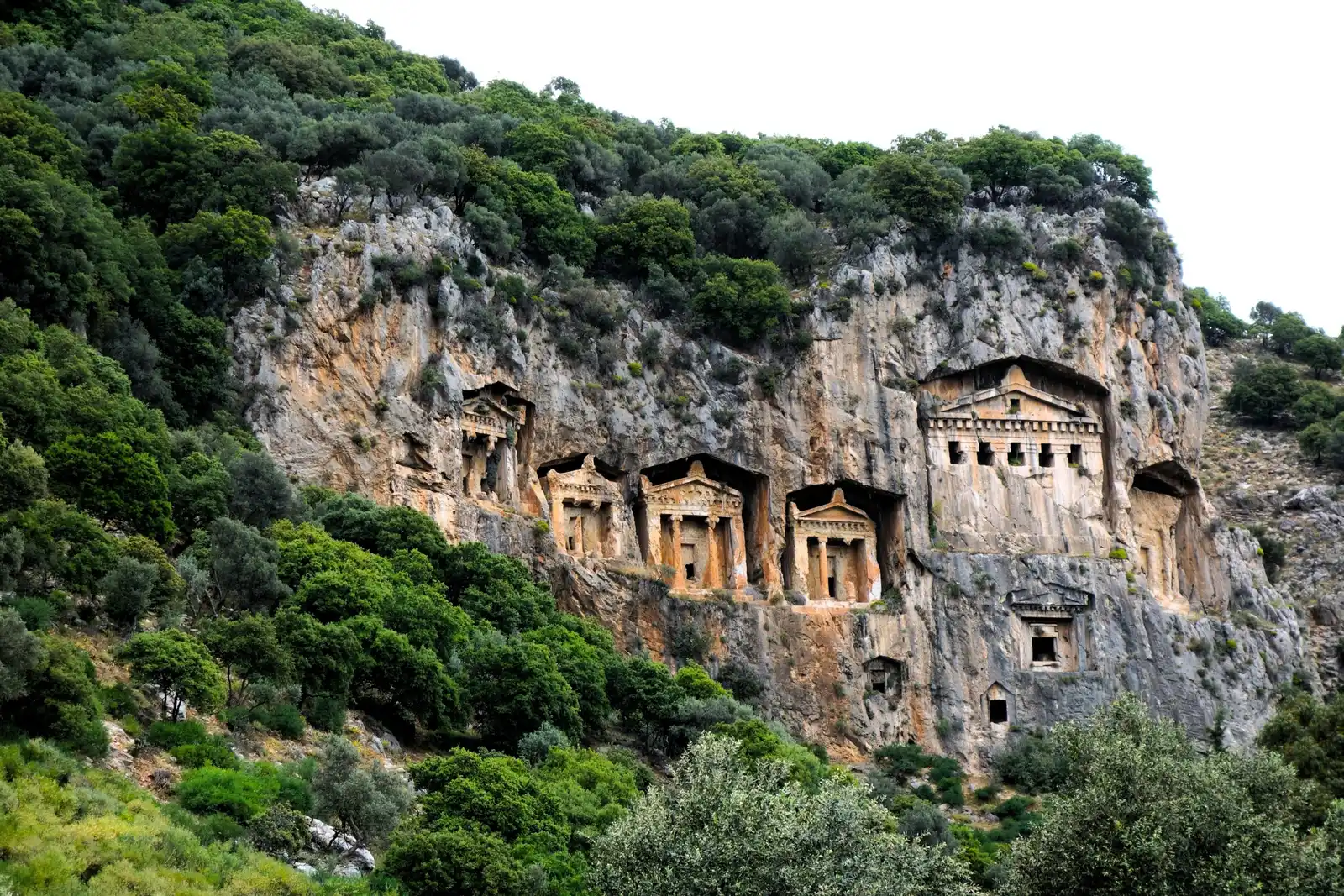
Table of Contents
- The rock tombs at a glance
- History: who was buried in the rock tombs?
- Lycian or Carian?
- How were they carved?
- The temple tombs: what you are looking at
- Best places to see the Dalyan rock tombs
- 1. The Dalyan riverfront (free)
- 2. From a river boat
- 3. Up close from the Çandır side
- Tips for visiting the rock tombs
- Nearby
The Dalyan rock tombs, often called the King’s Tombs, are a group of temple-fronted tombs carved high into the limestone cliffs on the far bank of the Dalyan river, opposite the town. They were cut in the 4th century BC for the rulers and leading families of the ancient city of Kaunos, and you can see them for free from the Dalyan riverfront, or up close by crossing the river by rowing boat.
They are the image most people have of Dalyan: columns and triangular pediments carved straight out of the rock face, glowing in the morning sun and lit up after dark. The tombs take visitors on a stroll through the pages of history and into a different world.
The rock tombs at a glance
| What | Monumental tombs carved into the cliff, with temple-style facades |
| Age | Mostly 4th century BC; some reused in Roman times |
| Where | Cliffs at Çandır, on the west bank of the Dalyan river, opposite Dalyan town |
| Belonged to | The ancient city of Kaunos |
| Cost to see | Free from the Dalyan riverfront; rowing boat across about 50 TL per person (2025) |
| Best time | Morning, when the sun is on the facades; lit up at night |
History: who was buried in the rock tombs?
The tombs belonged to Kaunos, a port city founded more than 2,800 years ago on the border between ancient Caria and Lycia. In the 4th century BC, when the region was ruled by the Carian Hekatomnid dynasty under the Persian Empire, the city’s elite commissioned these tombs as an expression of wealth and status.
According to the belief of the time, tombs placed as high as possible brought the dead kings and important people closer to the gods. This is why the most elaborate tombs are cut into the steepest part of the cliff, where they could be seen from the city and from every ship entering the harbour. They give important clues about the burial traditions of the Kaunians.
Lycian or Carian?
You will hear them called both Lycian tombs and Carian tombs. Kaunos was a Carian city, but it sat on the Lycian frontier, and carving tombs into rock faces is a typically Lycian custom. What makes the Kaunos tombs stand out is their facade: rather than imitating wooden houses, as many Lycian tombs do, they imitate Greek temples. UNESCO’s description of Kaunos singles out this unique facade typology.
How were they carved?
The tombs were carved from the top down. Masons cut a vertical face into the cliff, shaped the pediment, columns and doorway in the rock, and then hollowed out a burial chamber behind the facade, usually with stone benches for the dead. At least one of the facades was never finished, giving a rare glimpse of how the work progressed. One popular explanation is that the work was interrupted by Alexander the Great’s campaign or the end of Persian rule, although this cannot be proven.
The temple tombs: what you are looking at
The temple tombs are the most important group of rock tombs at Dalyan. Each one has:
- A triangular pediment at the top, sometimes with carved acroteria (ornaments) at its corners.
- Two Ionic columns framing the entrance, carved in relief from the rock.
- A porch and doorway leading to the tomb chamber.
- A burial chamber behind, with stone benches where the dead were laid.
Almost all the tombs were robbed in antiquity, so what survives is the architecture rather than grave goods. You will also see many smaller, simpler tombs scattered over the cliffs, which belonged to less wealthy families.
Best places to see the Dalyan rock tombs
1. The Dalyan riverfront (free)
The classic view is from the riverside promenade in Dalyan town, directly opposite the tombs. Walk south along the river from the centre, where restaurants and cafés have terraces facing the cliffs. The tombs face east, towards the town, so morning is when the sun falls directly on the facades; by late afternoon the sun has moved behind the cliff and they are in shade. After dark the tombs are illuminated, which gives the visitors a different pleasure.
2. From a river boat
Every Dalyan boat trip to Iztuzu Beach or the mud baths passes directly beneath the tombs, and many boats slow down for photos. It is the closest view you can get of the high King’s Tombs.
3. Up close from the Çandır side
For a closer look, take a rowing boat across the river from Dalyan to the village of Çandır (about 50 TL per person in 2025). From the landing, a path leads up past several tombs and continues for about 30 minutes to the entrance of the Kaunos ancient city. Wear proper shoes; the path is rocky and hot in summer. You can return the same way or by the car ferry further downstream.
Tips for visiting the rock tombs
- Time it for the light. The tombs face east across the river, so come in the morning for sunlit facades, or after dark for the illuminated view.
- Bring a zoom lens or binoculars. The details of the columns and pediments are high up.
- Combine with Kaunos. The tombs belong to the city, and seeing both together makes far more sense than either alone.
- Go at night. Dinner on the riverfront with the illuminated tombs opposite is one of the great Dalyan experiences.
- Respect the site. Don’t climb on the facades or leave anything inside the chambers.
Nearby
- Ancient City of Kaunos: the theatre, harbour and agora of the city that built the tombs.
- Iztuzu (Turtle) Beach: the river continues past the tombs to the sea.
- Dalyan mud baths and hot springs: upriver, on the way to Lake Köyceğiz.
Information checked against 2025–2026 sources in November 2026. Boat prices change each season, so please confirm locally.
Frequently asked questions
How old are the Dalyan rock tombs?
Most of the temple-fronted tombs were carved in the 4th century BC for the leading families of ancient Kaunos, and some were reused in the Roman period. That makes them around 2,400 years old.
Can you visit the Dalyan rock tombs for free?
Yes. You can see the tombs for free from the Dalyan riverfront, which is the best place to photograph them, in the morning sun or after dark when they are lit. To see them up close you cross the river by rowing boat to Çandır and walk up the path towards Kaunos.
Are the Dalyan rock tombs Lycian or Carian?
Both labels are used. Kaunos was a Carian city on the border with Lycia, and its tombs follow the Lycian tradition of carving tombs into cliffs, but their temple-style facades are distinctive. Locally they are usually called the Lycian or King's tombs.
Can you climb up to the rock tombs?
Several tombs can be reached on foot from the path between the Çandır landing and Kaunos, but the highest King's Tombs are on sheer cliffs and are best admired from below or from the river.
Are the tombs lit up at night?
Yes, the main group of tombs is illuminated after dark, which makes an evening walk or dinner on the Dalyan riverfront one of the nicest ways to see them.